Paleontology

Views of Namacalathus hermanastes fossils

An article published in the journal “Science Advances” reports an analysis of fossils of Namacalathus hermanastes, an organism that lived in the Ediacaran period. A team of researchers subjected exceptionally preserved fossils dating back approximately 547 million years to a sophisticated X-ray tomographic examination. This also allowed fossilized soft tissue to be found for the first time in this species. The details of the two specimens examined led to the discovery of the link between animals that lived in the so-called Cambrian explosion and one of their ancestors.

Dromomeron gregorii fossil (Photo courtesy Sterling Nesbitt)

An article published in the journal “Nature” reports a study on Dromomeron gregorii, an archodon reptile that lived just over 210 million years ago, in the Triassic period. A team of researchers subjected recently discovered fossil skulls of this species to a micro-CT scan to reconstruct the structure of their brains and sensory systems. This allowed them to detect many similarities with pterosaurs that, together with other anatomical similarities, convinced them that they’re the ancestors of these flying reptiles.

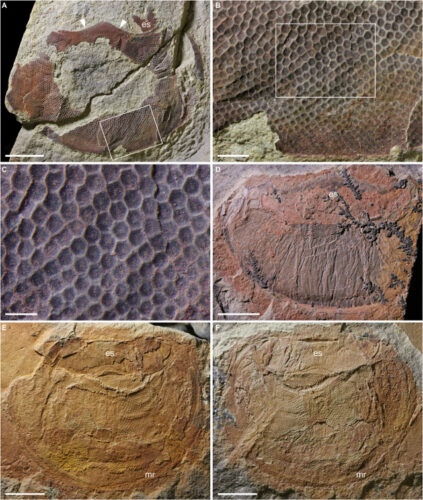
Details of Anomalocaris briggsi eyes (Image courtesy John Paterson et al.)

An article published in the journal “Sciences Advances” reports a study on the eyes of Anomalocaris briggsi, a radiodon that lived about 515 million years ago, in the Cambrian period. Fossils discovered in the Emu Bay Shale, Australia, were so well preserved that they retained the their eye structure, which was found to be similar to that of their arthropod cousins and consisted of over 13,000 lenses. A team of researchers led by Dr. John Paterson of the University of New England, New South Wales, Australia, conducted a thorough examination of these fossil eyes. The conclusion is that Anomalocaris briggsi had excellent eyesight and that vision already played a crucial role in that ancient ecosystem.

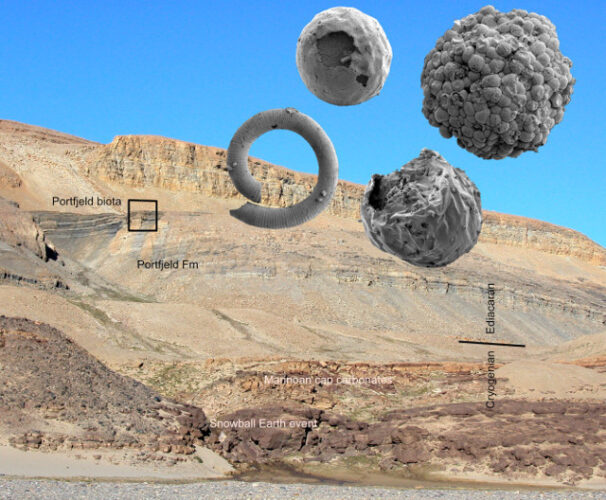
The Portfjeld Formation and some of the microfossils found in that area

An article published in the journal “Communications Biology” reports a study on microfossils with an age of up to 570 million years discovered in present-day Greenland. A team of researchers led by paleontologist Sebastian Willman of the University of Uppsala, Sweden, examined these microfossils, which have characteristics that suggest they may be animal eggs and embryos. They show similarities with other microfossils discovered in the Doushantuo Formation, in China, with an age close to 600 million years. This means that they were organisms that in such an ancient era were widespread all over the world and could be the remains of the first animals.

Kopidosaurus perplexus fossil with its 3D reconstructions

An article published in the journal “Scientific Reports” describes a new species of lizard now extinct that lived in present-day Wyoming, in the USA, about 52 million years ago, in the Eocene period. Simon Scarpetta, a paleontology student at the University of Texas (UT) at Austin, named it Kopidosaurus perplexus because the various analyzes carried out on the available fossil skull give different results regarding its classification. The relationships also vary considerably depending on the type of analysis conducted, underlining the difficulties and uncertainties that may exist in both paleontology and biology field.