Paleontology

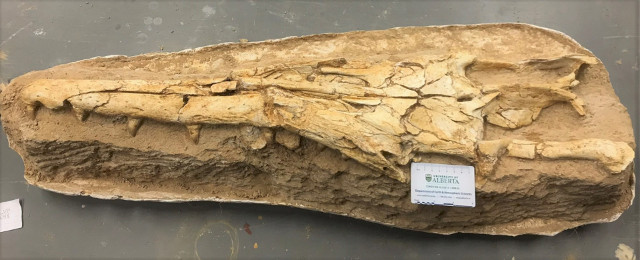
Gavialimimus almaghribensis fossil

An article published in the “Journal of Systematic Palaeontology” reports the identification of a new species of mosasaur that lived between 66 and 72 million years ago, in the Cretaceous period. A team of researchers led by Catie Strong, a student in the Department of Biological Sciences at the University of Alberta, Canada, named it Gavialimimus almaghribensis after examining a skull and some bones discovered in a mine in present-day Morocco. The researchers noted the similarities of the teeth with those attributed to Platecarpus ptychodon, another mosasaur whose fossils were discovered in Morocco, but question the taxonomic validity of that species, so they created a whole new genus for the identified species.

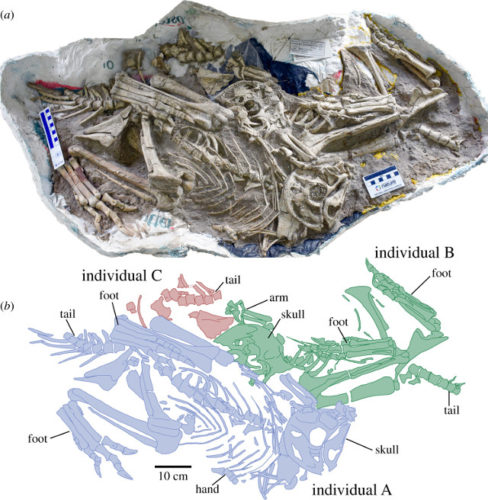
Oksoko avarsan fossils

An article published in the journal “Royal Society Open Science” reports the identification of a new species of parrot-like feathered dinosaur that lived in modern Mongolia about 68 million years ago, at the end of the Cretaceous period. A team of researchers named it Oksoko avarsan after examining various specimens in various states of incompleteness. Some of the specimens had been confiscated by the Mongolian authorities after they were found in the possession of smugglers. These dinosaurs were classified within the oviraptorid (Oviraptoridae) family, but were toothless and had two fingers instead of the typical three of their closest relatives.

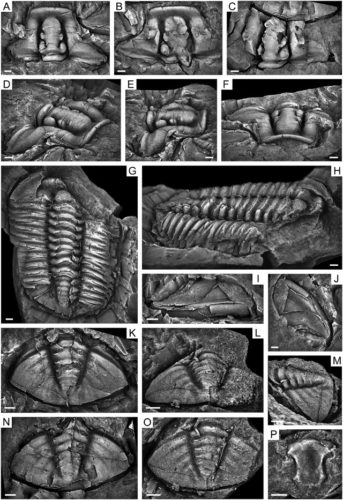
Views of Gravicalymene bakeri specimens

An article published in the journal “Alcheringa: An Australasian Journal of Palaeontology” reports the identification of a new species of trilobite that lived about 450 million years ago, in the Ordovician period, in today’s Tasmania. Dr. Patrick Smith of the Australian Museum Research Institute and Macquarie University and Dr. Malte Ebach of the University of New South Wales named it Gravicalymene bakeri assigning it to an already known genus and choosing the name of the species in honor of actor Tom Baker because he inspired them to become scientists by playing the protagonist of the famous TV show “Doctor Who”.

Molar of the Neanderthal man cataloged as Spy 94a

An article published in the journal “Science” reports the results of the sequencing of the Y chromosome, the one that determines the male sex among humans, of three Neanderthals and two Denisovans. A team of researchers led by Martin Petr and Janet Kelso of the Max Planck Institute for Evolutionary Anthropology performed high-quality sequencing using a very advanced approach to obtain the genetic sequences of the Y chromosomes of a total of 5 hominins. This made it possible to compare them with each other and with those of modern humans to obtain new information on the relationships among the various species. An interesting conclusion is that the Neanderthal Y chromosome was received from Homo sapiens with whom they must have interbred much earlier than we thought, no less than 100,000 years ago and possibly even 370,000 years ago.

Spinosaurus aegyptiacus skeleton

An article published in the journal “Cretaceous Research” reports the discovery of hundreds of teeth of Spinosaurus aegyptiacus in the ancient Kem Kem river system, along the border between today’s Morocco and Algeria. A team of researchers collected about 1,200 fossil teeth in an ancient river bed in today’s Morocco, and analysis revealed that nearly half of them were of Spinosaurus aegyptiacus. Their conclusion is that it’s evidence that about 100 million years ago, in the Cretaceous period, this dinosaur was well adapted to aquatic life, a confirmation of the thesis supported by a growing number of paleontologists.