Evolution

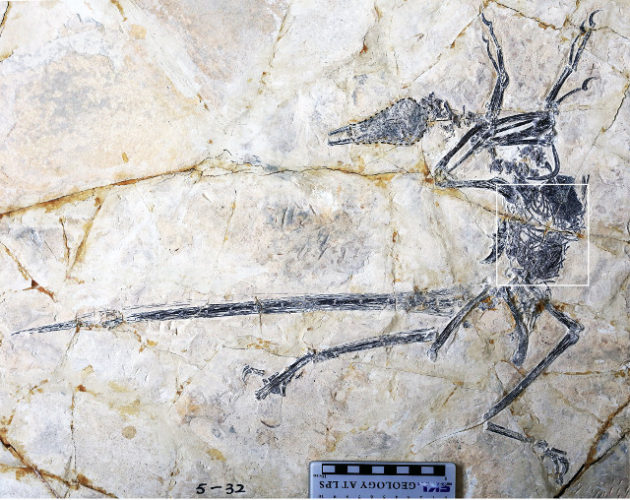
A feathered dinosaur of the species Microraptor zhaoianus discovered with an almost complete lizard in its stomach

An article published in the journal “Current Biology” reports the study of a specimen of a small feathered dinosaur belonging to the species Microraptor zhaoianus which is not only almost complete but still contained in its stomach the remains of a lizard belonging to a species that was still unknown and was named Indrasaurus wangi. A team of paleontologists led by Professor Jingmai O’Connor of the Chinese Academy of Sciences examined the remains of the two animals that lived about 120 million years ago in today’s China and, also based on three previous discoveries of Microraptor with a preserved prey in their stomach, confirmed the theory that this type of dinosaur was an opportunistic predator.

Perhaps the Cambrian explosion occurred thanks to a peculiar tectonic activity

An article published in the journal “Nature Communications” offers a possible explanation for the Cambrian explosion, the greatest diversification event among living organisms ever seen in the history of life on Earth. A team led by Josh Williams, now a PhD student at the University of Edinburgh, used sophisticated biogeochemical models to try to reproduce oxygen changes in the atmosphere just before that explosion concluding that it was the result of an out of the normal tectonic activity during the formation of the supercontinent Gondwana.

New clues that the origin of plumage goes back to at least 250 million years ago

An article published in the journal “Trends in Ecology & Evolution” reports new clues about the origin of plumage that confirm that it evolved starting from about 250 million years ago among some life forms that survived the devastating mass extinction that occurred at the end of Permian period. A team of researchers coordinated by the British University of Bristol combined information regarding fossils with others obtained through molecular biology analysis to obtain a conclusion that confirms a hypothesis made after the discovery of feathered pterosaurs.

Ambopteryx longibrachium was a tiny dinosaur with bat wings

An article published in the journal “Nature” reports the identification of a new species of dinosaur that lived around 163 million years ago, in the Late Jurassic period, which had some characteristics similar to those of birds but with wings more similar to those of pterosaurs or bats. A team of researchers coordinated by the Chinese Academy of Sciences named it Ambopteryx longibrachium and classified it in the family of scansoriopterygid, which could be close relatives of birds. This little dinosaur could provide important information about the development of flight among dinosaurs and therefore in birds.

Sterling Nesbitt with the bones of Suskityrannus hazelae he discovered (Photo courtesy Virginia Tech. All rights reserved)

An article published in the journal “Nature Ecology & Evolution” reports the identification of a new species of tyrannosauroid that lived about 92 million years ago, in the Mid-Cretaceous period. A team of researchers led by Sterling Nesbitt of Virginia Tech named this species Suskityrannus hazelae completing a work begun in 1997, when the first fossils were discovered but weren’t identified at the time. It was a carnivore but with its height of less than one meter it was much smaller than its far more famous distant cousin, the T.rex.