Evolution

The role of Ardipithecus ramidus in the evolution of bipedalism in humans

An article published in the journal “eLife” reports the claim that the foot morphology of Ardipithecus ramidus, a hominin that lived about 4.4 million years ago, is the most similar to that of chimpanzees and gorillas among apes. Thomas Prang of the New York University’s Department of Anthropology examined the characteristics of Ardipithecus ramidus’ feet to assess the relationship between the type of locomotion of a species and its skeletal characteristics. The aim is to reconstruct the evolution of bipedalism and estimate the appearance of the last common ancestor of humans and chimpanzees.

A study of coelacanth skulls offers clues to the evolution of vertebrates

An article published in the journal “Nature” reports the results of a study of the skull of Latimeria chalumnae, one of the two species of coelacanth existing today. A team of researchers led by Hugo Dutel of the British University of Bristol subjected several specimens to very sophisticated tests to create reconstructions of their skulls and brains from the fetal state to the adult state. The aim is to study these fish considered a living fossil to better understand the evolution of the skull in vertebrates and also the reason why the coelacanth brain occupies only 1% of the cranial cavity.

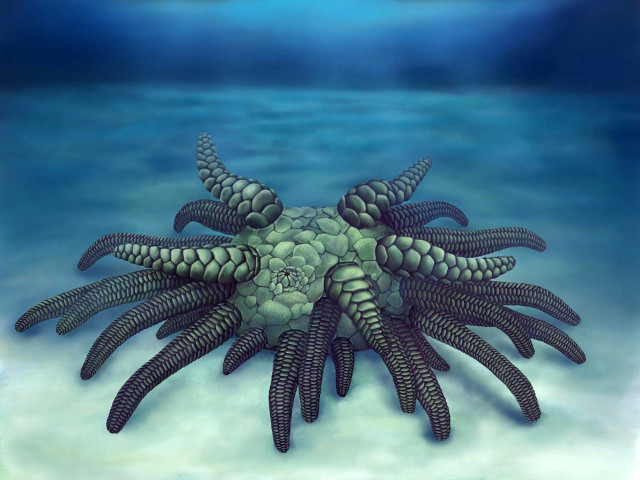
Artist's concept of Sollasina cthulhu (Image courtesy Elissa Martin)

An article published in the journal “Proceedings of the Royal Society B: Biological Sciences” reports the discovery of a species related to the animals of the class Holothuroidea, the ones commonly known as sea cucumbers, which was named Sollasina cthulhu for a certain resemblance to the creature invented by the writer H.P. Lovecraft. A team of researchers examined very well preserved fossils discovered in the English site of Herefordshire dating back to about 430 million years ago, during the Silurian period, using modern technologies to create a 3D reconstruction.

Peregocetus pacificus bones (Image courtesy G. Bianucci)

An article published in the journal “Current Biology” reports the discovery of the fossils of a quadruped whale in sea sediments near the coast of Peru, dated about 42.6 million years ago. A team of researchers named this new species Peregocetus pacificus, probably the oldest found in the Americas. The uncovered skeleton constitutes the first indisputable finding of fossils of amphibian cetaceans that could move on land and swim in sea waters.

Medusavirus is a giant virus with strange characteristics even for that type of organism

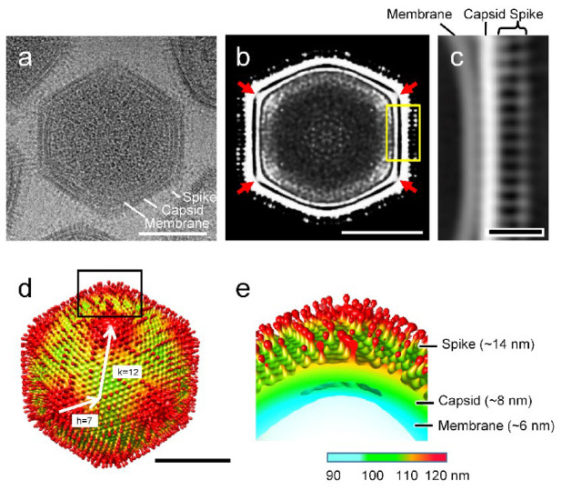
An article published in the “Journal of Virology” reports the discovery of a new giant virus that was called Medusavirus. A team of researchers discovered it in northern Japan’s hot springs, where it reproduces by infecting amoebae of the species Acanthamoeba castellanii. The peculiarity of Medusavirus is that it results in the formation of cysts in the infected amoebae, which leads to the growth of a protective covering.