Evolution

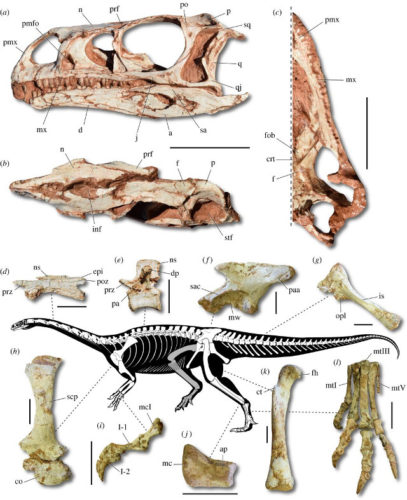
Saltriovenator zanellai available bones (Image G. Bindellini / C. Dal Sasso / M. Zilioli / M. Auditore)

An article published in the journal “PeerJ” describes the study of a carnivorous dinosaur of which a partial skeleton was discovered in 1996 near Saltrio, in the Varese province, about 80 kilometer North-East of Milan, Italy. Named Saltriovenator zanellai, it was classified as a part of the group of ceratosaurs, medium-large carnivorous dinosaurs, by Cristiano Dal Sasso, Simone Maganuco and Andrea Cau. It lived almost 200 million years ago and this makes it the oldest ceratosaurus discovered so far and with an estimated length of about 7.5 meters (about 25 feet) and probably at least one ton of weight it’s the largest theropod dinosaur of the time. Its characteristics offer information on birds’ three-fingered hands.

Pterosaur pycnofibres (Image courtesy Yang et al. All rights reserved)

An article published in the journal “Nature Ecology & Evolution” reports the discovery of two specimens of pterosaur that lived in today’s China about 165-160 million years ago, during the Jurassic period, that had filaments called pycnofibres that make up a plumage. A team of researchers studied under the microscope those pycnofibres finding four different types of feathers, concluding that they’re very similar to those of birds and those found in feathered dinosaur fossils.

Perhaps inosine was one of the components of the first life forms on Earth

An article published in the journal “Proceedings of the National Academy of Sciences” describes a study on the possible precursors of RNA. A team of Harvard University biologists led by Nobel Prize laureate Jack Szostak is trying to reconstruct the various steps that led to the birth of life with lab experiments and an interesting result came from the use of inosine as a surrogate for guanine, one of the RNA and also DNA bases.

Neanderthal and Modern human skulls (photo ©hairymuseummatt)

An article published in the journal “Nature Ecology & Evolution” describes a research on the number of interbreedings between Homo sapiens and Neanderthals. Fernando A. Villanea and Joshua G. Schraiber of the Temple University offered evidence to support the thesis of multiple interbreedings. Fabrizio Mafessoni of the Max Planck Institute for Evolutionary Anthropology (MPI-EVA) in Leipzig, Germany, published in the same journal a commentary on that research, pointing out that this thesis is in agreement with the increasing evidence of interbreedings between different hominids.

Macrocollum itaquii is the oldest long-necked dinosaur discovered so far

An article published in the journal “Biology Letters” describes the discovery of a dinosaur of the sauropodomorph group that lived in today’s Brazil in the Late Triassic period, about 225 million years ago. Rodrigo Temp Müller and Sérgio Dias-da-Silva of the Universidade Federal de Santa Maria together with Max Cardoso Langer of the Universidade de São Paulo discovered an ancestor of the famous giant long-necked dinosaurs, which was named Macrocollum itaquii. It’s a useful discovery to clarify the evolution of that group of herbivorous dinosaurs.