Evolution

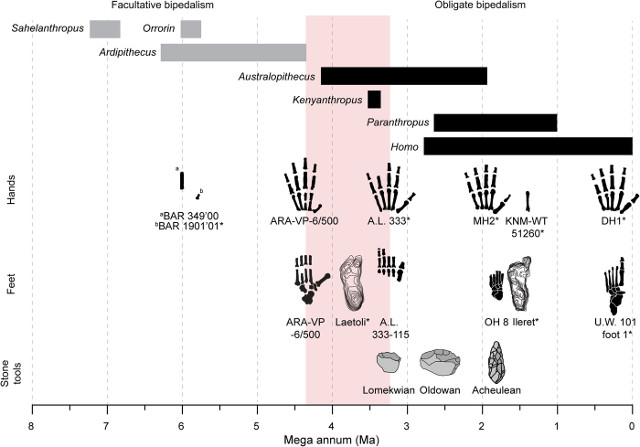
A scheme of the evolution of the hands and feet of hominins

An article published in the journal “Science Advances” reports a study of the hands of Ardipithecus ramidus, a hominin that lived about 4.4 million years ago. Thomas Cody Prang, a professor of anthropology at Texas A&M University, and some colleagues examined the particularly well-preserved fossil hands of the specimen nicknamed Ardi. A comparison with the hands of modern humans, apes, and monkeys provided new insights into their evolution and connection with their locomotion showing a correlation between the evolution of hand and foot characteristics.

Artist's reconstruction of the steppe mammoth (Image courtesy Beth Zaiken / Centre for Palaeogenetics)

An article published in the journal “Nature” reports the sequencing of DNA fragments of some mammoth specimens even older than one million years. A team of researchers used advanced paleogenetic techniques to extract DNA from three teeth discovered in the 1970s, one from an early woolly mammoth and two assigned to the species it descended from, known as the steppe mammoth. These are the oldest genomes sequenced so far, and indicate among other things that the mammoth that inhabited North America during the last ice age was a hybrid between the woolly mammoth and mammoths belonging to a hitherto unknown genetic line. These findings offer new insights into the evolution of mammoths and their adaptation to cold climates.

Reconstruction of Pederpes finneyae with the bones of its forelimb

An article published in the journal “Science Advances” reports a study on the evolution of the forelimbs’ skeleton and muscles in the transition from fish to tetrapods. A team of researchers led by Julie Molnar of the New York Institute of Technology and Stephanie Pierce of Harvard examined three-dimensional models of the bones, joints, and muscles of the fins and limbs of two now-extinct early tetrapods and a fish closely related to them. The conclusion is that those early tetrapods had anatomical features more suited to propulsion than to support their weight.

Views of Namacalathus hermanastes fossils

An article published in the journal “Science Advances” reports an analysis of fossils of Namacalathus hermanastes, an organism that lived in the Ediacaran period. A team of researchers subjected exceptionally preserved fossils dating back approximately 547 million years to a sophisticated X-ray tomographic examination. This also allowed fossilized soft tissue to be found for the first time in this species. The details of the two specimens examined led to the discovery of the link between animals that lived in the so-called Cambrian explosion and one of their ancestors.

Dromomeron gregorii fossil (Photo courtesy Sterling Nesbitt)

An article published in the journal “Nature” reports a study on Dromomeron gregorii, an archodon reptile that lived just over 210 million years ago, in the Triassic period. A team of researchers subjected recently discovered fossil skulls of this species to a micro-CT scan to reconstruct the structure of their brains and sensory systems. This allowed them to detect many similarities with pterosaurs that, together with other anatomical similarities, convinced them that they’re the ancestors of these flying reptiles.