Evolution

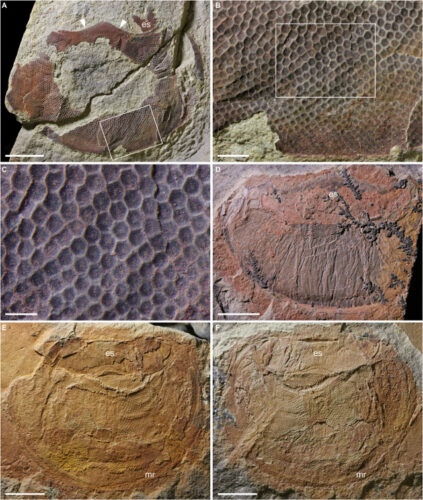
Details of Anomalocaris briggsi eyes (Image courtesy John Paterson et al.)

An article published in the journal “Sciences Advances” reports a study on the eyes of Anomalocaris briggsi, a radiodon that lived about 515 million years ago, in the Cambrian period. Fossils discovered in the Emu Bay Shale, Australia, were so well preserved that they retained the their eye structure, which was found to be similar to that of their arthropod cousins and consisted of over 13,000 lenses. A team of researchers led by Dr. John Paterson of the University of New England, New South Wales, Australia, conducted a thorough examination of these fossil eyes. The conclusion is that Anomalocaris briggsi had excellent eyesight and that vision already played a crucial role in that ancient ecosystem.

Australian lungfish (Neoceratodus forsteri)

An article published in the journal “Science Advances” reports a study on Australian lungfish (Neoceratodus forsteri) that offers new information on the evolution of fish fins into tetrapod limbs. A team of researchers led by Dr. Joost Woltering of the German University of Konstanz studied, in particular, the anatomical and genetic characteristics of Neoceratodus forsteri’s embryos. The result was the confirmation of the importance of some genes with new information on the genes involved and the discovery of a primitive hand in this fish’s fins, suggesting an evolution of fingered limbs through embryonic changes.

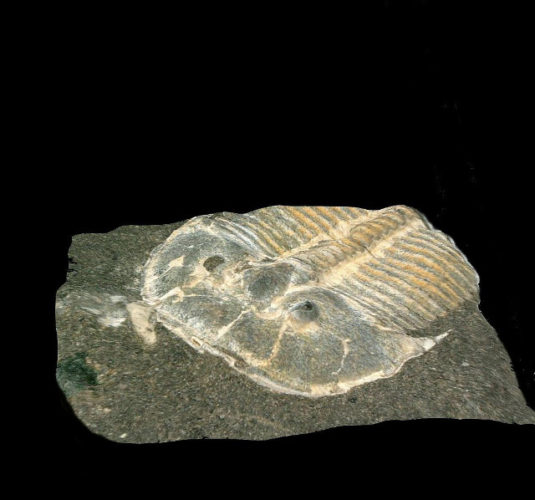
Aulacopleura kionickii fossil (Photo courtesy Brigitte Schoenemann)

An article published in the journal “Scientific Reports” reports a study on the eyes of a fossil of Aulacopleura kionickii, a species of trilobite that lived about 429 million years ago, which offers evidence that it had a vision comparable to that of its distant modern cousins, insects but also crustaceans. Dr. Brigitte Schoenemann of the University of Cologne, Germany, and Euan Clarkson of the University of Edinburgh, Scotland, examined fossil eyes using digital microscopy to find in those compound eyes structures similar to those that exist today in bees, dragonflies, and many crustaceans with diurnal habits.

Sinlhouette of Lusovenator santosi with the available bones

An article published in the “Journal of Vertebrate Paleontology” reports the identification of a carnivorous dinosaur that lived in today’s Portugal between 153 and 145 million years ago, in the Jurassic period. A team of researchers led by Dr. Elisabete Malafaia of the Portuguese University of Lisbon named it Lusovenator santosi and attributed it to the Carcharodontosauria group, part of the larger group of allosaurs, carnivorous dinosaurs that were superpredators in their ecosystems. This species is very ancient within its group and its discovery offers some new information on the first phase of these dinosaurs’ diversification, which is currently poorly known due to the scarcity of fossils.

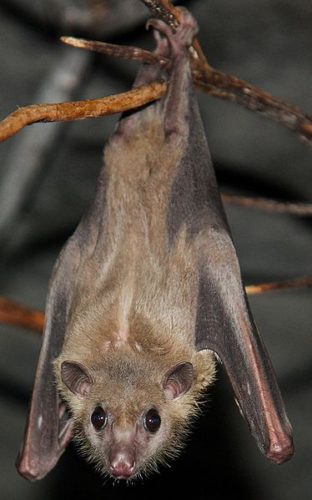
Rousettus aegyptiacus

An article published in the journal “Nature” reports a genetic research on bats which reveals some of their characteristics that makes them particularly resistant to viruses and also to cancer. A team of scientists from the Bat1K consortium, which aims to sequence the genomes of all bat species, generated and analyzed six genomes of the highest quality that make them ten times more complete than the ones previously available. This allowed to identify a series of genes that help explain the evolution of flight and echolocation.