Evolution

Silhouette of Overoraptor chimentoi with the bones found

An article published in the journal “Science of Nature” reports the identification of a new species of dinosaur with characteristics similar to birds that lived about 90 million years ago, in the Cretaceous period, in today’s Patagonia, Argentina. A team of researchers led by Matias Motta named it Overoraptor chimentoi, a name that reminds more of predatory dinosaurs than birds. In fact, some of its characteristics are typical of that type of dinosaur, with legs suitable for running and a claw similar to that of Velociraptor on its second toe. Instead, its arms have characteristics much closer to bird wings, and this suggests that it’s one of the species closest to birds among the various known raptors.

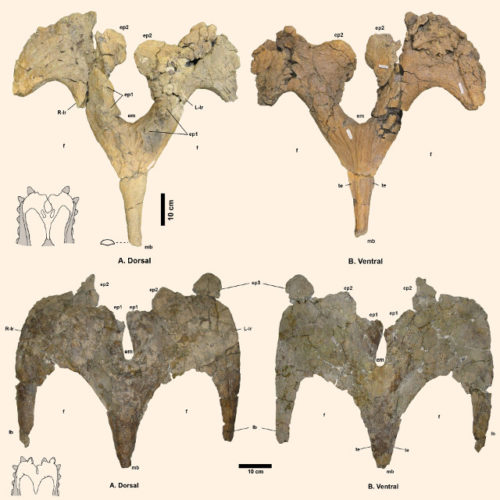
Bones of Navajoceratops sullivani and Terminocavus sealeyi

An article published in the journal “PeerJ” reports the discovery of two species of horned dinosaurs that lived about 75 million years ago, in the Cretaceous period, in today’s New Mexico, USA. Dr. Denver W. Fowler and Dr. Elizabeth A. Freedman Fowler examined fragments of skulls discovered in the Kirtland Formation, New Mexico, and attributed them to two hitherto unknown species of herbivorous dinosaurs from the ceratopsid family naming them Navajoceratops sullivani and Terminocavus sealeyi. According to the two researchers, these are transitional species between two previously known species: Pentaceratops sternbergii and Anchiceratops ornatus. This could also be true for a third possible species that appears to belong to the same group even if researchers haven’t identified it with certainty due to the fragmentary nature of the fossils discovered.

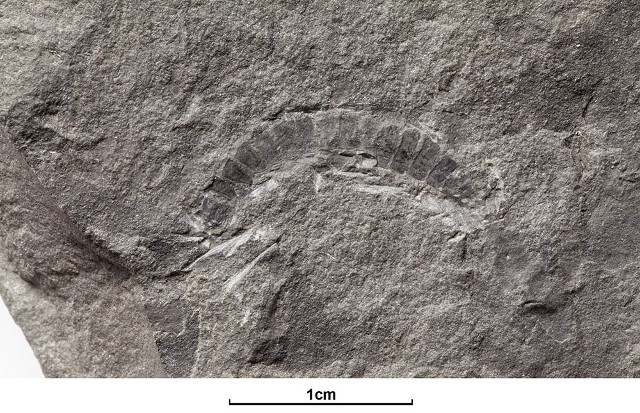
Kampecaris obanensis

An article published in the journal “Historical Biology” reports a dating of sediments in three British sites where the oldest millipede fossils were found conducted by researchers from the University of Texas at Austin. The result is that the site on the Scottish island of Kerrera is the oldest, 425 million years old, making Kampecaris obanensis the oldest known millipede. This result is important not only for establishing which millipedes among the various British sites are the oldest but in general for the evolution of arthropod groups which include myriapods, insects, and arachnids, linked to that of plants. Their evolution appears to have been faster than previously thought, arriving at complex ecosystems from simple communities in 40 million years.

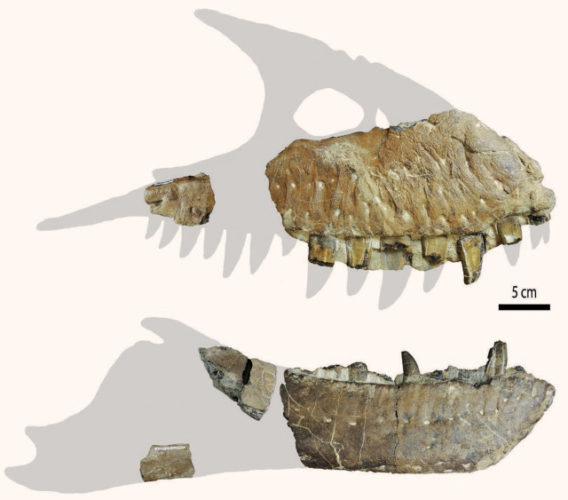
Thanatotheristes degrootorum fossil bones

An article published in the journal “Cretaceous Research” reports the identification of a new species of tyrannosaurid that lived in today’s Canada about 80 million years ago, in the Cretaceous period. A team of researchers named it Thanatotheristes degrootorum after examining a partial skull with the bones of the upper and lower jaws, discovered in 2010 near the city of Hays. The characteristics of the available fossils convinced the researchers that it was a tyrannosaurid of a different species from the ones already known, the oldest discovered in Canada, useful to understand the evolution of the family to which the iconic T. rex belongs.

An Asgard archaeon could provide the key to understanding the birth of the eukaryotic cell

An article published in the journal “Nature” reports a study on an archaeon called Candidatus Prometheoarchaeum syntrophicum, part of the proposed phylum Lokiarchaeota. A team of researchers took samples from the bottom of the Pacific Ocean near the Japanese coasts, managing to cultivate these Archaea contained in a special laboratory environment specifically created. Years of studies made it possible to separate various strains and to discover that some have long and branched protrusions, a feature that led the researchers to suggest that in the past a bacterium became entangled in similar protrusions becoming an organelle of what became over time a eukaryotic cell.