Evolution

Parioscorpio venator is the oldest known scorpion and could show the transition between aquatic and land life

An article published in the journal “Scientific Reports” illustrates the identification of the oldest known scorpion species, which lived about 437 million years ago, in the Silurian period. A team of researchers named it Parioscorpio venator after examining fossils discovered in a quarry in Wisconsin in 1985. This species had some anatomical features that are practically identical to those of modern scorpions but the most interesting discovery is in the respiratory structures that indicate that it could live on the mainland. This is the oldest evidence that an animal could survive out of the sea and indicates that at the time at least a part of arachnids had already colonized the mainland.

Aegicetus gehennae was a whale with legs that lived 35 million years ago

An article published in the journal “PLOS ONE” reports the identification of an ancient species of whale that was named Aegicetus gehennae. It lived about 35 million years ago, in the Eocene period, in an area that is now occupied by the Egyptian desert. A team of paleontologists examined a skeleton that’s exceptionally complete for this type of animal and a second partial skeleton concluding that it was a species belonging to the protocetid family, cetaceans that were probably amphibians. This new species represents an intermediate stage between the most primitive whales, which used using their feet to swim, and the modern ones that swim using their tail, providing information on their evolution.

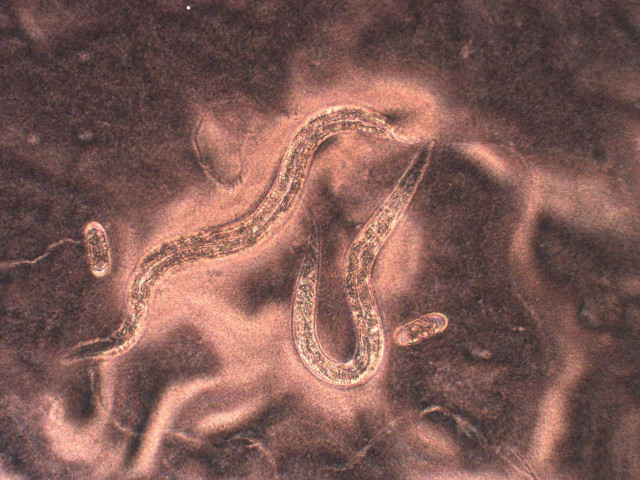
Halicephalobus mephisto (Image courtesy John Bracht, American University)

An article published in the journal “Nature Communications” reports the DNA sequencing of a nematode nicknamed “Devil Worm” whose scientific name is Halicephalobus mephisto. A team of researchers led by Dr. John Bracht of the American University sequenced the DNA of this worm only half a millimeter long to try to understand the genetic reasons behind its ability to live even at over 3 kilometers deep underground in warm water veins, where there’s little oxygen and a large amount of methane. An article published in the “Journal of Molecular Evolution” reports the examination of some genes that this nematode has in common with some molluscs adapted to live in warm environments.

New fossils of an ancient legged snake called Najash rionegrina offer new information on the evolution of snakes

An article published in the journal “Science Advances” reports the study of new fossils of a snake belonging to the species Najash rionegrina, which lived in the Cretaceous period, between 90 and 100 million years, in today’s Patagonia, Argentina. A team of researchers led by Fernando Garberoglio of the Fundación Azara at Universidad Maimónides in Buenos Aires, Argentina, subjected various fossils belonging to this species, which had well-developed limbs, to a high-resolution CT scan to obtain new information on the evolution of snakes.

Fukuipteryx prima fossil (Image courtesy Imai et al)

An article published in the journal “Communications Biology” reports the identification of a bird that lived about 120 million years ago, in the Cretaceous period, that was named Fukuipteryx prima. A team of researchers led by Dr. Takuya Imai examined a partial skeleton discovered in today’s Japan noting some features similar to those of the famous Archeopteryx. It’s one of the most primitive birds discovered, particularly outside China, and offers information on the evolution of flight thanks also to its preservation in three dimensions.