Evolution

Danuvius guggenmosi fossil bones offer clues to the evolution of bipedal posture

An article published in the journal “Nature” reports a study on fossils of an ape species that was named Danuvius guggenmosi that lived about 11.6 million years ago, during the Miocene period, in today’s Bavaria. A team of researchers led by Professor Madelaine Böhme of the Eberhard-Karls-Universität of Tübingen examined bones belonging to at least four individuals that combine adaptations of bipeds and apes that hang from tree. This suggests that the ancestors of today’s humans and apes had that kind of characteristics and bipedal locomotion evolved in species that still lived at least partially on trees.

According to a genetic research, humanity's birthplace is in today's Botswana

An article published in the journal “Nature” reports the results of an analysis of modern humans’ mitochondrial DNA to reconstruct the Homo sapiens family tree. A team of researchers led by Eva Chan of the Genomics and Epigenetics Division of the Garvan Institute of Medical Research and the University of New South Wales made a complex genetic analysis concluding that the modern human species emerged about 200,000 years ago in today’s Botswana, near the Zambezi River.

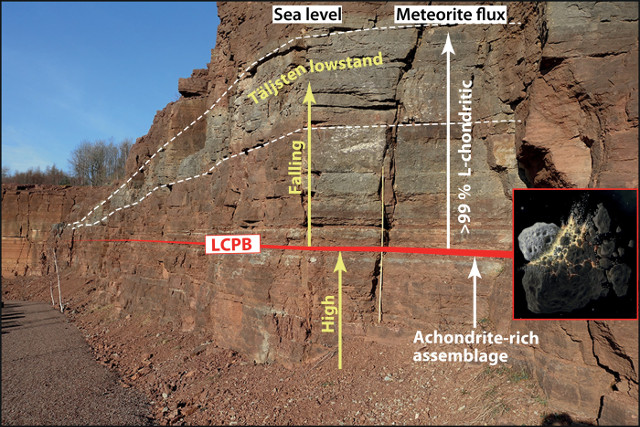
An impact in the asteroid belt might have triggered the Great Ordovician Biodiversity Event on Earth

An article published in the journal “Science Advances” reports a study linking the fragmentation of an asteroid between Mars and Jupiter about 466 million years ago to what is known as the Great Ordovician Biodiversity Event (GOBE). A team of researchers led by geologist Birger Schmitz of Lund University, Sweden, analyzed micrometeorites from that era. The ones of L-type chondrite type that can be linked to the fragments of that asteroid date back to the time of the ice age that marked the beginning of that biodiversity.

The study of the pelvis of a Rudapithecus hungaricus offers clues to the evolution of the bipedal posture

An article published in the “Journal of Human Evolution” reports the study of a partial pelvis of Rudapithecus hungaricus, a hominid that lived about ten million years ago, in the Miocene period, in today’s Hungary related to both modern African apes and human beings. A team of researchers led by Carol Ward of the University of Missouri analyzed that fossil bone concluding that human bipedal posture has more ancient origins than previously thought.

Kamuysaurus japonicus was a duck-billed dinosaur that lived 72 million years ago

An article published in the journal “Scientific Reports” describes the identification of a new species of duck-billed dinosaur that lived about 72 million years ago, in the Late Cretaceous period, in today’s Japan. A team of paleontologists led by Professor Yoshitsugu Kobayashi of the Japanese Hokkaido University Museum named it Kamuysaurus japonicus and classified in the family of hadrosaurids after examining the almost complete skeleton available.