February 2021

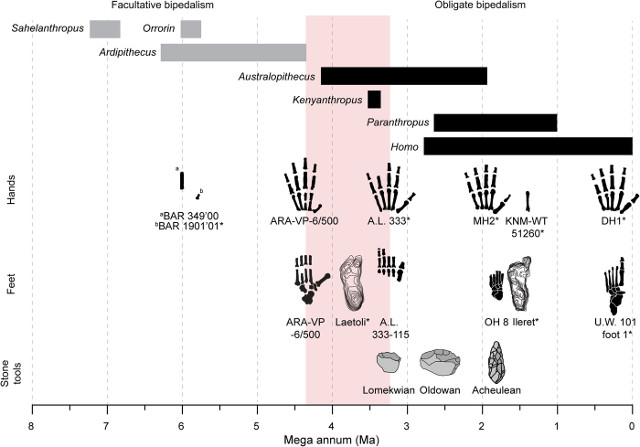
A scheme of the evolution of the hands and feet of hominins

An article published in the journal “Science Advances” reports a study of the hands of Ardipithecus ramidus, a hominin that lived about 4.4 million years ago. Thomas Cody Prang, a professor of anthropology at Texas A&M University, and some colleagues examined the particularly well-preserved fossil hands of the specimen nicknamed Ardi. A comparison with the hands of modern humans, apes, and monkeys provided new insights into their evolution and connection with their locomotion showing a correlation between the evolution of hand and foot characteristics.

Paradox Lost by George Mann

The novel “Paradox Lost” by George Mann was published for the first time in 2011.

The Tardis suddenly appears to be in a frenzy to reach her destination. When she materializes, the Eleventh Doctor, Amy, and Rory are in London in 2789, where they discover a group of people recovering an android from the Thames. Intrigued, the Doctor manages to pass himself off as an inspector and examine the android, which turns out to be centuries old despite having been built using the most advanced technologies of that period.

The Doctor manages to reactivate the android who, before running out of all his remaining energy, reveals that he has been waiting for him for over a millennium and warns him that the Squall are coming and that Gradius’s timeship caused a hole in time. To solve the mystery, the Doctor must go to 1910, where he enlists the help of Professor Angelchrist while Amy and Rory continue their investigation into the origins of the android in 2789.

The novel “Dune” by Frank Herbert was published for the first time in 1965 combining two parts previously serialized in the magazine “Analog”. It’s the first book in the Dune saga. It won the Hugo and Nebula awards for best novel of the year.

Emperor Padishah Shaddam IV has assigned the planet Arrakis to Duke Leto Atreides, the only place in the universe where the spice that prolongs life and increases certain mental powers grows. Arrakis is also known as Dune because it’s a single large desert, and among the creatures that inhabit it, there are giant worms.

Duke Leto Atreides prepares to move his house from the planet Caladan to Arrakis but knows that the desert and his worms are just some of the dangers that await him, his concubine Jessica, and their son Paul. The Atreides will take over from the Harkonnens, with whom there is a centuries-old feud, so the Duke knows that there will be deadly traps waiting for him.

Illustration of the diversity of bacteriophage viruses of the human gut microbiome

An article published in the journal “Cell” reports the discovery of over 140,000 bacteriophage viruses that live in the human guts, added to a new database called the Gut Phage Database (GPD). A team of researchers led by Dr. Luis Camarillo-Guerrero of the Wellcome Sanger Institute analyzed more than 28,000 gut microbiome samples collected from different parts of the world to detect bacteriophage viruses using metagenomics. Over half of the viruses identified were unknown so far. These viruses attack bacteria, so they can help the body’s immune responses.

Artist's reconstruction of the steppe mammoth (Image courtesy Beth Zaiken / Centre for Palaeogenetics)

An article published in the journal “Nature” reports the sequencing of DNA fragments of some mammoth specimens even older than one million years. A team of researchers used advanced paleogenetic techniques to extract DNA from three teeth discovered in the 1970s, one from an early woolly mammoth and two assigned to the species it descended from, known as the steppe mammoth. These are the oldest genomes sequenced so far, and indicate among other things that the mammoth that inhabited North America during the last ice age was a hybrid between the woolly mammoth and mammoths belonging to a hitherto unknown genetic line. These findings offer new insights into the evolution of mammoths and their adaptation to cold climates.