
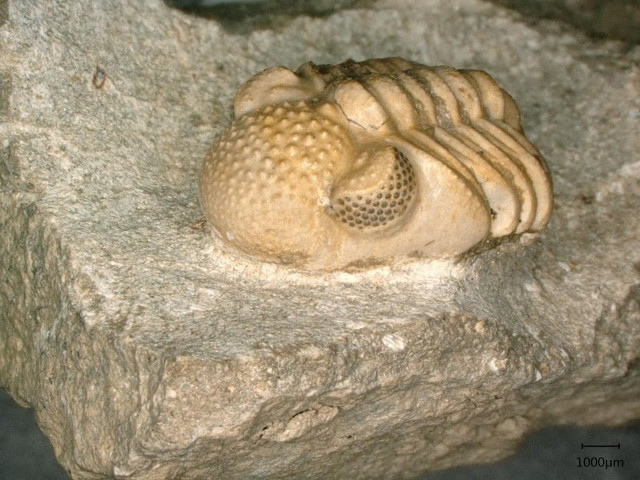
An article published in the journal “Scientific Reports” reports a study on the eyes of the trilobites of the Geesops schlotheimi species, which lived about 390 million years ago. A team of researchers led by zoologist Brigitte Schoenemann examined fossils of this trilobite and old X-ray images of fossils to study its eyes. The structure of those eyes is peculiar even among trilobites and exists only in the order Phacopida: it features a small number of relatively large, well-separated, lenses, each covered by its own cornea. It’s a sophisticated structure that perhaps was useful for seeing in low light.
Brigitte Schoenemann conducted several studies on trilobites and in particular on their eyes: an overview regarding their sight was published in March 2021 in the journal “Arthropod Structure & Development”. These arthropods had sophisticated eyes, which were compound eyes similar in many ways to those of many crustaceans and insects, their distant cousins. However, not all trilobites had eyes of the same type, as those belonging to the order Phacopida had developed eyes of the type called in jargon schizochroal and defined as hyper-compound in this new research.
Simplifying the concept, most trilobites had eyes called in jargon holocroal composed of many lenses covered with a cornea while Phacopida had fewer, much larger, lenses each with their own cornea. Schizochroal eyes constitute a unique development in a phylum as vast as that of arthropods, a case that remained isolated due to the extinction of the order Phacopida. This occurred at the end of the Devonian period, about 360 million years ago, well before the disappearance of all trilobites in the largest mass extinction in the history of the Earth, which occurred just over 250 million years ago, at the end of the Permian period.
The interest in the study of schizochroal eyes is limited to a niche but in the 1970s the amateur paleontologist Wilhelm Stürmer worked on them in such a way that became relevant even for the professionals in the sector. That’s because he pioneered X-ray examinations of fossils and also examined trilobites of the order Phacopida.
The conformation of the schizochroal eyes was left without an explanation for the distance between the various lenses, an apparent inefficiency thinking that there seems to be wasted space since it cannot perceive light. Now Brigitte Schoenemann’s team offers an explanation for that kind of eye development that came after conducting new examinations using more modern techniques such as tomography.
Species such as Geesops schlotheimi, originally classified as Phacops schlotheimi and then reassigned to another genus, clearly show its schizochroal eye structure and well-preserved specimens are excellent objects of study. According to Brigitte Schoenemann’s team, each of the lenses of those eyes covered a structure that formed a small eye whose components formed one or two rings. Wilhelm Stürmer had found filaments under those eyes and speculated that they were nerves, a conclusion confirmed by this new study.
According to Brigitte Schoenemann’s team, Phacopida trilobites had what they called hyper-compound eyes, with a structure that had a sensitivity to light that was perhaps much higher than that of the normal compound eyes typical of their cousins. This was a useful evolutionary adaptation in the low-light marine environment in which they lived. This confirms that trilobites had very sophisticated eyes a few hundred million years ago. Certainly, they contributed to the success of this group of arthropods.
