
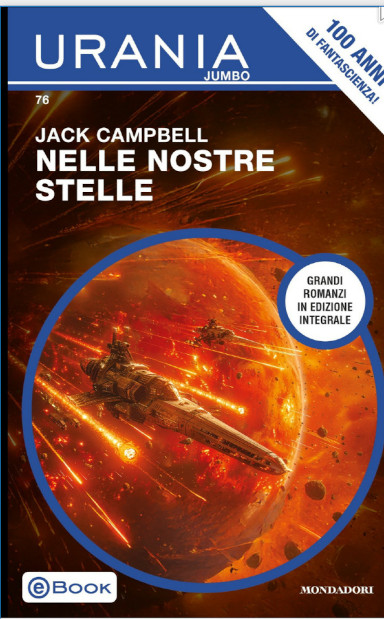
The novel “In Our Stars” byJack Campbell was published for the first time in 2024. It’s the first book in “The Doomed Earth” duology.
Lieutenant Selene Genji of the Unified Fleet watches in horror as Earth is destroyed. The weapon that achieved such a devastating effect also creates a ripple in space-time that sends her and the spaceship Pyrenees back in time approximately 40 years. The Earth Guard spaceship Vigilant, patrolling the area, discovers the wreck of the Pyrenees and Selene, who is still alive.
When Selene Genji awakens on the Vigilant, she thinks she has been captured by members of the Spear of Humanity. She realizes she is in 2140, but the doctor treating her discovers that part of Selene’s DNA is alien, and gets scared. Lieutenant Kayl Owen is intrigued and decides to help her, but someone in the Earth Guard simply wants to get rid of them.
“In Our Stars” is the first half of a duology by Jack Campbell, the pen name of John G. Hemry, a well-known military science fiction author. The premise isn’t exactly original, with the protagonist, Selene Genji, transported back in time after witnessing the destruction of Earth by a xenophobic organization called the Spear of Humanity.
A central element is the protagonist’s nature, as she’s the product of genetic engineering aimed at uniting two species years after first contact between humans and the Tramontine aliens. This type of hybrid is called an alloy, and Selene constantly repeats that she’s a alloy, emphasizing in every way how this has led to discrimination throughout her life. The problem isn’t just hers, because xenophobia was (will be?) a crucial element in the movement that destroyed Earth to cleanse it of aliens.
Lieutenant Kayl Owen becomes embroiled in Selene Genji’s attempt to prevent Earth’s destruction and, in the process, improve relations with the Tramontine, who are about to reach Mars in 2140. The theme of xenophobia is developed, sometimes with explicit parallels to racism, and Jack Campbell shows various ramifications through people’s reactions when they discover Selene is part alien and when the Tramontine reach Mars. The diversity of those reactions is also used to demonstrate how even a single person can make a difference and bring about significant change through their actions. Selene is willing to do anything to change the future, and in her efforts, she must convince humanity that the Tramontine are friends.
In recounting the obstacles Selene Genji and Kayl Owen face, Jack Campbell shows how xenophobia isn’t the sole cause of Earth’s future destruction, as the decline of the Earth Guard appears to have significantly facilitated it. Kayl’s personal story helps illustrate how bureaucrats, and even corrupt individuals, manage to rise to the highest levels of the hierarchy. Humanity’s problems in 2140 seem in many ways similar to those we face today, even with mass surveillance, which isn’t really a remedy for crime.
These themes are developed without any particular subtlety within an action-packed plot. The two protagonists are on the run practically from the beginning of the novel because someone within the Earth Guard wants them dead. The story follows their points of view, so it’s unclear who is a xenophobic fanatic, who is corrupt, and who is a bureaucrat simply following orders. The arrival of the Tramontine aliens seems to have caused significant reactions, which have had strong repercussions on Selene and Kayl, too.
I can’t say “In Our Stars” is bad; in fact, I think it’s well-written. The fast-paced, action-packed story makes up for the lack of subtlety in developing the important themes. If that’s okay with you, you might enjoy it, but be aware that this is only half the story and you’ll need to read the sequel to get the full story. You can find it on Amazon USA, UK, and Canada.
