
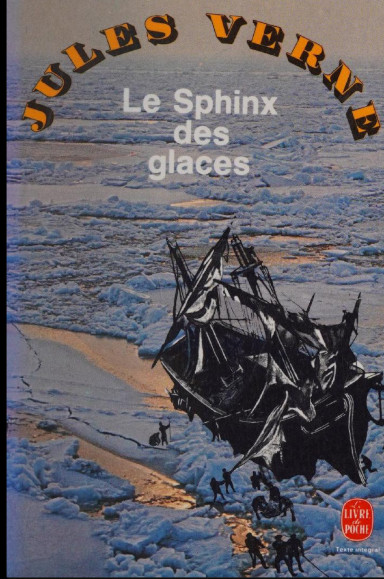
The novel “An Antarctic Mystery” (“La Sphinx des glaces”) by Jules Verne was published for the first time in 1897. It was published in various translations into English, sometimes with the title “The Sphinx of the Ice Realm”.
Jeorgling intends to return to the USA after spending time in the Kerguelen Islands for personal reasons. He asks to be accepted as a passenger on the ship Halbrane, but Captain Len Guy initially seems vehemently opposed. However, when the captain discovers that Jeorgling is from Connecticut and knows the story of Arthur Gordon Pym, he changes his mind.
During the voyage, the Halbrane encounters an iceberg on which the body of a sailor from the ship Jane is found. The man has a note stating that other members of his crew are still alive. Jeorgling believed that Arthur Gordon Pym’s story was fictional, but he must accept the idea that it’s a true account.
“An Antarctic Mystery” is a sequel to the novel “The Narrative of Arthur Gordon Pym of Nantucket.” Jules Verne was one of the many readers inspired by Edgar Allan Poe’s work, in his case, to the point of continuing its story. Set just over a decade after the adventures of Arthur Gordon Pym, it’s a sort of meta-narrative in which Verne plays on the fact that Poe’s novel was originally published as a real travelogue.
The narrator of this sequel is Jeorgling, an American searching for a ship to take him home. Circumstances lead him to become a passenger on a ship heading south, where he finds himself retracing, at least in part, the journey undertaken by Arthur Gordon Pym.
Edgar Allan Poe had told a story that included some mysteries, especially concerning the fate of the protagonist’s various traveling companions. In a story that in some ways is even more adventurous than Poe’s, Jules Verne attempts to offer solutions to at least some of those mysteries.
In some cases, plot developments centered on the mysteries of Edgar Allan Poe’s novel occur through twists and turns that can significantly change the sense of one or more characters’ actions. At the beginning of the novel, Jeorgling simply wants to return home after a period spent in the Kerguelen Islands, but he ends up embroiled in an adventure tied to what he thought was merely a fantasy tale, with people whose motivations he only understands after discovering their secrets.
All this makes “An Antarctic Mystery” a novel in the style of Jules Verne, and the result is one of what can be called his extraordinary journeys. In this case, it involves a journey to the Antarctic region, which was still relatively unknown at the time. This choice makes this novel quite different from “The Narrative of Arthur Gordon Pym of Nantucket,” also because the tension and dangers are very different from those focused on psychological horror described by Edgar Allan Poe.
Jules Verne’s novel was labeled science fiction due to certain elements, such as the one connected to the sphinx mentioned in the original title. It’s above all an adventure based on the exploration of what, at the time it was written, were the mysteries of the region around the South Pole. It’s inevitable that “An Antarctic Mystery” is somewhat anachronistic today, but it can still be appreciated by readers who love sea adventures full of danger and twists.
