
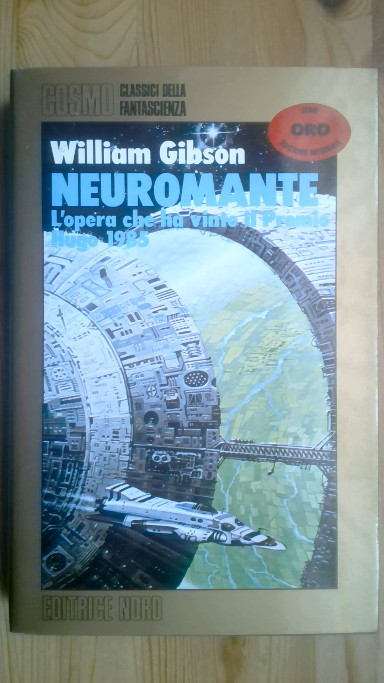
The novel “Neuromancer” by William Gibson was published for the first time in 1984. It won the Hugo, Nebula, and Philip K. Dick awards as the best novel of the year.
Case was a so-called console cowboy until he tried to steal from his employer. Discovered, the punishment he suffered was worse than death because his nervous system was damaged in a way that prevented him from connecting to the Matrix. Since that day, he has been looking for a cure that will allow him to return to cyberspace.
After a series of disappointments, Case is contacted by Armitage, a mysterious man who offers him a cure in exchange for helping him on a complex mission. Together with Molly, a woman with special physical enhancements, he must go to the Sprawl and steal a ROM that contains the personality record of a hacker who died a while ago. That’s only the first phase of a mission full of difficulties and surprises.
In the early years of his career as a writer, William Gibson published various short stories in which he laid the foundation for subsequent cyberpunk novels. This subgenre had various precursors, different authors who explored some of the elements that became important in cyberpunk. Gibson put those elements together in “Neuromancer” in a way that marked this subgenre.
The cyberspace created by William Gibson and the characters that connect to it live in a world with dystopian features. These are elements that have become iconic even if they weren’t all very original. Over the years, the author developed them with his own unique style that contributed to his fame and the spread of cyberpunk even beyond the world of science fiction.
“Neuromancer” has a linear plot compared to other later William Gibson novels but it’s not an easy reading. The author’s descriptions are very visual but the plot structure is quite convoluted. The various stages of Case’s adventure are a bit like the levels of a video game with leaps from one place to another.
Cyberspace is a highly technological construct and yet its exploration and also the jargon associated with it are more connected to a “pop” language than to computer science. It’s a choice that can make the story more accessible to readers who have no particular knowledge of computer science. On the contrary, it can create perplexity in readers who have real knowledge on the subject and may not find any familiarity in William Gibson’s kind of descriptions.
The success of cyberpunk owes much to an extrapolation that goes far beyond technology and concerns certain negative trends that were already present in Western society in the 1980s. The dystopian consequences of the growing economic power of multinationals have become a paradigm for cyberpunk stories.
The story’s dark tones given by the dystopian elements and the setting that echoes noir stories help to make the story somewhat depressing. This didn’t hinder the success of “Neuromancer”, rather it helped.
Technology evolved differently from what was described in “Neuromancer”, for example with mobile devices. Some of the more advanced developments may come in the future but in some ways today it feels like living in a cyberpunk world. This novel still remains the paradigm of this type of story, so it’s still a must-read for anyone interested in possible social and economic developments even more than technological ones beyond genre labels.
